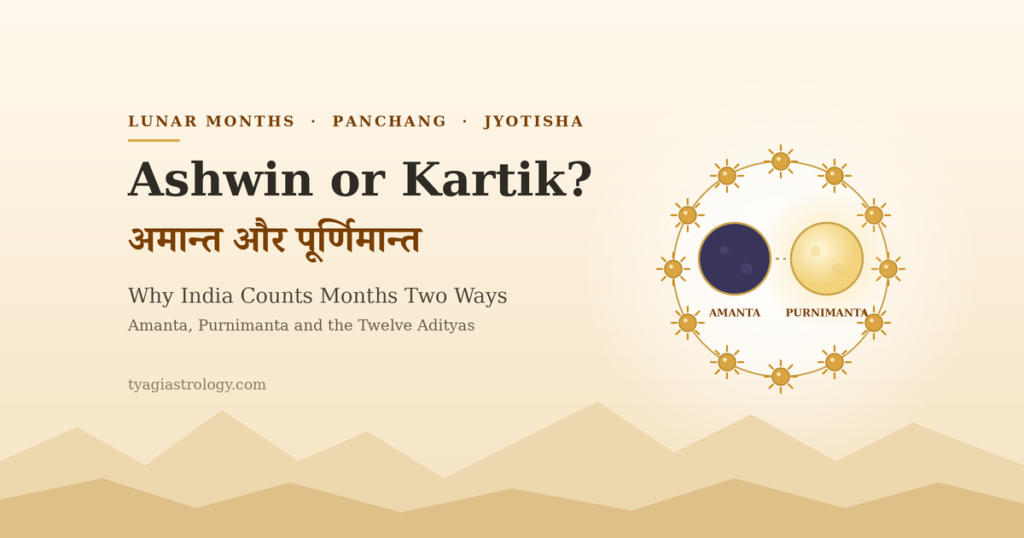

On 28 October 2026, the astronomical day is Kṛṣṇa Tritīyā. Under Amānta reckoning it belongs to Āśvina, while under Pūrṇimānta reckoning it belongs to Kārttika. Nothing about the Moon, Tithi or Nakshatra changes what changes is the month to which the waning fortnight is assigned. This post explains why India counts its lunar months in two ways, how a month actually gets its name, what the twelve Adityas have to do with the months, and where the month matters in a panchang, a birth chart and a muhurta.
The historical idea of Māsa
The history of the Indian month is best understood not by beginning with Chaitra, Vaiśākha and Jyeṣṭha, but by going further back. The Taittirīya Saṃhitā 4.4.11 preserves a twelve-month series organised directly through the six seasons:
| Ṛtu | First Vedic month | Second Vedic month | Later conventional correspondence |
| Vasanta | Madhu | Mādhava | Chaitra – Vaiśākha |
| Grīṣma | Śukra | Śuci | Jyeṣṭha – Āṣāḍha |
| Varṣā | Nabhas | Nabhasya | Śrāvaṇa – Bhādrapada |
| Śarad | Iṣa | Ūrja | Āśvina – Kārttika |
| Hemanta | Sahas | Sahasya | Mārgaśīrṣa – Pauṣa |
| Śiśira | Tapas | Tapasya | Māgha – Phālguna |
From seasonal names to Nakshatra names
At some stage the familiar stellar names—Chaitra, Vaiśākha, Jyeṣṭha and the rest—became established. The textual basis for understanding their relationship with Nakshatras is unusually explicit.
Sūrya Siddhānta 14.15 states:
nakṣatranāmnā māsās tu jñeyāḥ parvāntayogataḥ
The month is known by the name of the Nakshatra connected with the end of the parvan. The traditional commentary interpreted here by Burgess takes that boundary as the end of the bright fortnight—in other words, the Full Moon. Verse 14.16 then distributes neighbouring Nakshatras among the twelve month names.
This gives a much more accurate formulation than the popular statement:
“Chaitra is the month in which the Full Moon must be in Chitrā.”
The classical rule is more flexible. Sewell and Śaṅkara Bālakṛṣṇa Dīkṣit reproduce the traditional grouping as follows.
| Lunar month | Nakshatra zone associated with its Pūrṇimā |
| Kārttika | Kṛttikā, Rohiṇī |
| Mārgaśīrṣa | Mṛgaśīrṣa, Ārdrā |
| Pauṣa | Punarvasu, Puṣya |
| Māgha | Āśleṣā, Maghā |
| Phālguna | Pūrvaphālgunī, Uttaraphālgunī, Hasta |
| Chaitra | Chitrā, Svātī |
| Vaiśākha | Viśākhā, Anurādhā |
| Jyeṣṭha | Jyeṣṭhā, Mūla |
| Āṣāḍha | Pūrvāṣāḍhā, Uttarāṣāḍhā, with Abhijit in the older scheme |
| Śrāvaṇa | Abhijit, Śravaṇa, Dhaniṣṭhā |
| Bhādrapada | Śatabhiṣaj, Pūrvabhādrapadā, Uttarabhādrapadā |
| Āśvina | Revatī, Aśvinī, Bharaṇī |
This is one of the most important corrections to make in a serious article on Māsa.
Āśvina does preserve a relationship with Aśvinī; Chaitra with Chitrā; Kārttika with Kṛttikā; Vaiśākha with Viśākhā. But the classical astronomical tradition itself does not insist that every Full Moon for all eternity must fall inside one exact namesake Nakshatra. Sūrya Siddhānta 14.16 deliberately allows neighbouring stellar divisions, and its commentary explains why a rigid one-to-one lock cannot be maintained by the actual motions of Sun and Moon.
This also explains why testing a modern year and discovering that only some Full Moons fall in the exact namesake Nakshatra does not disprove the stellar origin of the month names.
How a Hindu month is actually calculated
The phrase “Hindu month” hides several distinct measures of time. The Sūrya Siddhānta opens its chapter on time measures by enumerating nine mānas and then says that four—Saura, Cāndra, Ārkṣa and Sāvana—have practical human application. It is therefore more precise to speak of multiple measures of time rather than simply claiming that Hinduism possesses four mutually interchangeable calendars.
Sūrya Siddhānta 14.12 defines the Tithi through 12 degrees of relative Sun–Moon motion, and 14.14 states that thirty Tithis compose a lunar month. It further says that vows, fasting, journeys, marriage and other ceremonies are determined by lunar reckoning.
This gives a useful modern formulation:

with the angular difference taken modulo 360°. A Cāndra Māsa is therefore not fundamentally “thirty sunrise days.” It is thirty units of changing Sun–Moon elongation. Because the apparent speeds of the Sun and Moon vary, a Tithi is not a fixed twenty-four-hour interval. The official Rashtriya Panchang likewise defines Tithi by each additional 12° of longitudinal separation and recognises lunar months between successive new-moon or full-moon boundaries.
Saura Māsa, by contrast, follows Sūrya. Sūrya Siddhānta 14.10 says that the twelve beginning with Meṣa are solar months and together constitute the year. The instant of the Sun’s entry into a new Rāśi is Saṅkrānti or Saṅkramaṇa. The same chapter treats Saṅkrānti as a calendrically and ritually significant moment and even discusses its puṇyakāla.
Thus:
Meṣa Saṅkrānti begins a new solar Rāśi-period;
Vṛṣabha Saṅkrānti the next;
Mithuna Saṅkrānti the next;
and so through all twelve signs. This is why Makara Saṅkrānti is astronomically different in kind from, say, Kārttika Pūrṇimā. The former is a solar ingress; the latter is a lunar month–Tithi combination.
The general rule became, the Amānta lunar month containing Meṣa Saṅkrānti is Chaitra, and the others follow in sequence.
Thus the working sequence is:
| Lunar month | Saṅkrānti occurring in the regular Amānta lunation |
| Chaitra | Meṣa |
| Vaiśākha | Vṛṣabha |
| Jyeṣṭha | Mithuna |
| Āṣāḍha | Karka |
| Śrāvaṇa | Siṃha |
| Bhādrapada | Kanyā |
| Āśvina | Tulā |
| Kārttika | Vṛścika |
| Mārgaśīrṣa | Dhanu |
| Pauṣa | Makara |
| Māgha | Kumbha |
| Phālguna | Mīna |
If no Saṅkrānti occurs in an Amānta lunation, that lunar month is Adhika. If two Saṅkrāntis occur in one lunation, a Kṣaya month-name results.
An Adhika Māsa is therefore not an arbitrary thirty-day block inserted by a priest or calendar-maker. Astronomically, the lunation would have occurred anyway. What is exceptional is that the Sun does not cross a Rāśi boundary during it, so the calendrical system must repeat a month-name in order to preserve the Sun–Moon relationship.
Adhika and Kṣaya are consequences of reconciling two real astronomical cycles. They are not “superstitious extra months.” The underlying problem is mathematical; the ritual consequences assigned to those months belong to Dharmaśāstra and Muhūrta traditions.
Why India counts months two ways
This is the part where I have to separate what I found from what I could not. The Moon gives two natural anchors. The new Moon is astronomically exact, the moment Sun and Moon dwell together, which is what amā-vāsya means. The full Moon is the one anyone can see. Either can start a month.
On what came first, the evidence I know points to the bright half first. Vedic ritual texts call the bright half pūrva-pakṣa, the earlier half, and the dark half apara-pakṣa, the later one. The Vedanga Jyotisha, the oldest surviving calendar text, describes its five-year cycle as beginning with the bright half of Magha and ending with the dark half of Pausha. That is the order of an Amanta count, with the dark half closing the month. Please verify both points in the texts before quoting them.
The two systems then split along regions and eras. As Drik Panchang and several calendar sources describe it, Purnimanta is followed in Bihar, Chhattisgarh, Haryana, Himachal Pradesh, Jammu and Kashmir, Jharkhand, Madhya Pradesh, Odisha, Punjab, Rajasthan, Uttarakhand and Uttar Pradesh. Amanta is followed in Andhra Pradesh, Karnataka, Maharashtra, Gujarat, Goa and others, and the daily calendars of Tamil Nadu, Kerala and Bengal are solar. The Vikram Samvat of the north is counted Purnimanta, and the Shaka era of the Deccan Amanta. Gujarat is a hybrid: it uses the Vikram era with Amanta months, and its year begins on Kartik Shukla Pratipada, the day after Diwali. So ‘North and South’ is a rough label. Gujarat and Maharashtra are in the west, and Odisha in the east counts Purnimanta.
What I could not find is a source that explains why the north moved to full-moon counting. The suggestions I have seen are plausible but unproven. One is that the Purnima is the visible anchor, and the day of many rites. Another is simply regional schools of calendar-making. The ritual digests accept both counts and generally defer to local usage, which is why a family keeps the system of its region (please check P. V. Kane, History of Dharmashastra, vol. V part 1, chapter XVIII).
The twelve Ādityas and the sacred solar year
The association of twelve months with the twelve Ādityas is not a modern astrological invention.
The Bṛhadāraṇyaka Upaniṣad 3.9.5 asks Yājñavalkya, “Which are the Ādityas?” His answer identifies them directly with the twelve months of the year, adding that they proceed by “taking” all things with them. Śaṅkara’s commentary interprets this in relation to the passage of life and the fruits of action as time moves forward.
This is conceptually profound. The twelve Ādityas are not merely twelve decorative names placed alongside twelve calendar boxes. At this Upaniṣadic level, the passage of the twelve months itself is an Āditya-form of Time.
The Śatapatha Brāhmaṇa likewise connects the twelvefold year with cosmic and human structures, while the Vedic seasonal month series of the Taittirīya Saṃhitā situates each pair of months within one of six Ṛtus. The year is thus simultaneously astronomical, ritual, seasonal and theological.
Later Purāṇas personify this structure more fully. Both the Viṣṇu Purāṇa 2.10 and Śrīmad Bhāgavata Purāṇa 12.11 describe Sūrya travelling through the year accompanied each month by a changing retinue including an Āditya/Solar form, Ṛṣi, Gandharva, Apsaras, Nāga, Yakṣa and Rākṣasa. The Viṣṇu Purāṇa further says that these monthly groups participate in the seasonal production of heat, cold and rain.
Here an especially important textual discovery emerges:
The Purāṇas do not preserve one completely identical month-to-Āditya list.
That needs to be stated openly, because many contemporary astrology websites present one list as though it were the single uncontested “Vedic” assignment.
| Māsa | Vedic seasonal name | Ṛtu | Āditya in Bhāgavata Purāṇa 12.11 | Solar form in Viṣṇu Purāṇa 2.10 |
| Chaitra | Madhu | Vasanta | Dhātā | Dhātā |
| Vaiśākha | Mādhava | Vasanta | Aryamā | Aryamā |
| Jyeṣṭha | Śukra | Grīṣma | Mitra | Mitra |
| Āṣāḍha | Śuci | Grīṣma | Varuṇa | Varuṇa |
| Śrāvaṇa | Nabhas | Varṣā | Indra | Indra |
| Bhādrapada | Nabhasya | Varṣā | Vivasvān | Vivasvān |
| Āśvina | Iṣa | Śarad | Tvaṣṭā | Pūṣā |
| Kārttika | Ūrja | Śarad | Viṣṇu | Parjanya |
| Mārgaśīrṣa | Sahas | Hemanta | Aṃśu | Aṃśu |
| Pauṣa | Sahasya | Hemanta | Bhaga | Bhaga |
| Māgha | Tapas | Śiśira | Pūṣā | Tvaṣṭā |
| Phālguna | Tapasya | Śiśira | Parjanya | Viṣṇu |
The fundamental doctrine is older and broader than any one twelve-name table: the twelve months are related to the twelvefold Āditya/solar year. The exact month-by-month personalisation is elaborated differently in Purāṇic traditions. The Bṛhadāraṇyaka Upaniṣad, notably, identifies the months themselves as Ādityas but does not supply the later twelve-name monthly sequence.
This distinction should shape how an astrologer teaches the subject.
It is legitimate to say:
“The Purāṇic tradition contemplates the solar year through twelve Āditya manifestations.”
It is too strong to say:
“The Vedas universally decree that Kārttika is ruled by this one Āditya and therefore every native born in Kārttika necessarily has these traits.”
A popular reading, and my caution. Because an Aditya is a form of the Sun, and the Sun is a graha, some astrologers speak of Surya worship in particular months. Kartik is the example. Chhath Puja, the great Sun festival, falls on 15 November, while the Sun is still in Tula, its sign of debilitation, until Vrischika Sankranti on 16 November. As with Diwali, I would read that as imagery and not as a mechanism.
Masa in the panchang
A panchang has five limbs: tithi, vara, nakshatra, yoga and karana. The month and fortnight frame them. A festival is really a triple of month, paksha and tithi, and the opening words of every puja sankalpa say so by naming the year, the half-year, the season, the month, the fortnight, the tithi, the weekday and the nakshatra.
This is where the two systems matter in practice. A Shraddha anniversary, a lunar birthday (janma-tithi) and any family vrata are recorded as month plus tithi. A death anniversary on Kartik Krishna Ashtami in a Purnimanta family is on Ashwin Krishna Ashtami in an Amanta family, and the day on the calendar is the same. The consequence is simple. Record which system a family follows, and do not switch midway.
Māsa in natal astrology
I want to be honest about this one. In Parashari natal interpretation the lunar month by itself is rarely a factor. What it tells you comes through two things it implies.
The first is the Sun. Through the Sankranti rule, the month name fixes the Sun’s sign to within about a month. The second is the tithi, which is the Moon’s distance from the Sun. Together, month and tithi place the Sun and the Moon to within a few degrees. That is useful. If a family says only that someone was born on Diwali night or on Karwa Chauth, the month and tithi narrow the Sun and Moon enormously, even when the clock time is lost. That is a real help in rectification and in reconstructing a lost birth date.
Traditional janma patrikas open with the Hindu date: the year, half-year, season, month, fortnight, tithi, weekday and nakshatra. Annual charts do not use lunar months at all, because the Varshaphal is cast when the Sun returns to its natal position. There is also a practical astronomical use. A remembered traditional birth date such as “Kārttika Śukla Navamī” contains more information than a modern reader may realise. Māsa narrows the annual solar region; Pakṣa locates the Moon in the waxing or waning half of the lunation; Tithi constrains the angular separation of Sun and Moon; and Nakshatra, if remembered, constrains the Moon’s sidereal longitude still further. This can therefore assist the reconstruction of an uncertain historical birth date.
Māsa in electional astrology
The surprise here is that marriage muhurta mostly ignores the lunar month. As Drik Panchang summarises the Muhurta Chintamani, wedding dates are chosen by the Sun’s sign. The signs that suit a wedding are Mesha, Vrishabha, Mithuna, Vrischika, Makara and Kumbha. Dhanu and Meena are Kharmas and are avoided, and Simha and Kanya overlap Chaturmas.
The lunar month enters in three ways. No samskara is performed in an Adhika month, and the Dharmasindhu is emphatic on this. The same restriction applies to a Kshaya month. And Chaturmas, the four months of Vishnu’s sleep, runs from Ashadha Shukla Ekadashi to Kartik Shukla Ekadashi. This year it ends with Prabodhini Ekadashi on 20 November.
A short practical summary
- A bright-half tithi has one name across India. Only a dark-half tithi is renamed.
- For vratas, Shraddha and lunar birthdays, follow your family’s regional system and keep to it.
- For a wedding or housewarming, check the Sun’s sign, the Adhika and Kshaya months and Chaturmas.
- For a birth record, note the Gregorian date, and if the family gave a Hindu date, which system they use.
- Treat the nakshatra rule and the Aditya list as traditions. The Sankranti rule decides the name.
So tomorrow, in Delhi, it will be Kartik, and in Hyderabad it will still be Ashwin. The Moon will be in Bharani and will not mind either way.