
A Tyagi Astrology perspective
A tradition older than the label “Vedic Astrology”
When we hear the words “Vedic Astrology” today, most of us immediately imagine a kundli: twelve houses, nine grahas, nakshatras, dashas and a prediction about life. But history is more layered than that. The Sanskrit word Jyotisha carries a wider meaning connected with celestial observation, calendar-making, ritual timing and, later, the interpretation of human and worldly events.
This distinction matters. It would be inaccurate to claim that the complete system practised by a modern astrologer appears fully formed in the earliest Vedic literature. What we can say with confidence is that close observation of the sky, the lunar cycle, seasons and ritual time became an important Indian knowledge tradition. Over centuries, that tradition developed, absorbed new techniques, produced major texts and took the sophisticated forms we recognise today.
The early purpose: understanding time
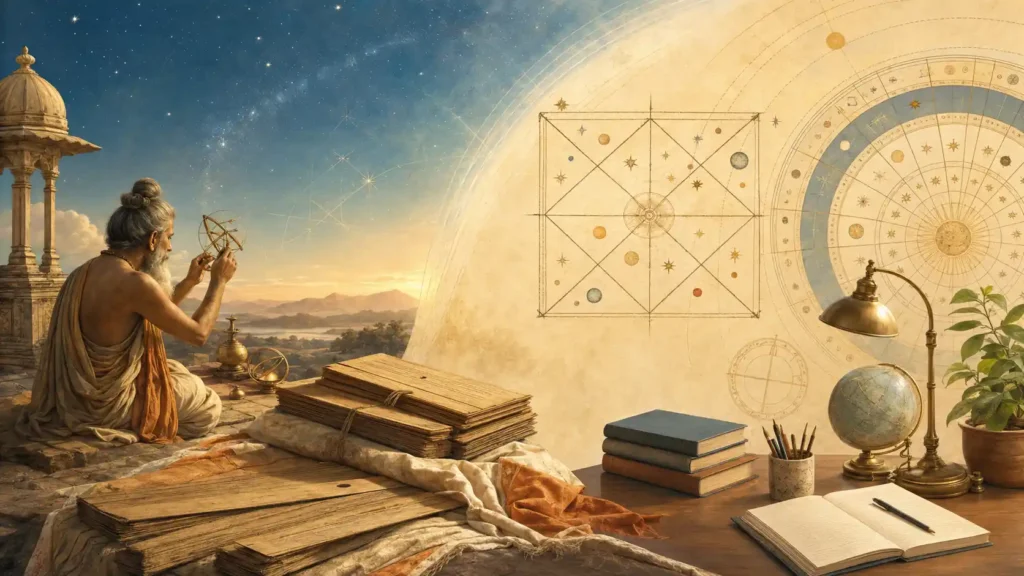
One of the earliest surviving texts associated with this tradition is the Vedanga Jyotisha, traditionally attributed to Lagadha. Its central concern is not the detailed judgement of an individual horoscope. It deals with the reckoning of time required for Vedic ritual: lunar days, months, seasons, solstices and the coordination of solar and lunar cycles.
This tells us something important about the original practical spirit of Jyotisha. Human beings needed to know when to perform an activity. The sky was not treated merely as decoration. It was a dependable clock, calendar and seasonal guide. The nakshatras—the lunar mansions along the Moon’s path—were especially important in organising this relationship between celestial movement and earthly time.
From calendar knowledge to predictive astrology
The next stage was not a single overnight invention. Indian astral knowledge evolved through observation, mathematical astronomy, inherited ritual traditions and intellectual exchange with other cultures. Scholars generally recognise interaction between Indian and Hellenistic astral sciences, especially in the development of horoscopy, zodiacal signs and certain technical methods. Acknowledging exchange does not make Jyotisha less Indian. Knowledge traditions often grow by receiving an idea, testing it, translating it and giving it a distinctive new structure.
Texts connected with Yavana traditions show this process, while works such as the Brihat Jataka of Varahamihira demonstrate that natal astrology was already highly organised in classical India. The chart now became a framework for reading temperament, circumstances and possible life outcomes through planets, signs, houses, aspects and combinations.
The classical synthesis
Varahamihira, who lived in the sixth century CE, remains one of the most important names in the history of Indian astral sciences. His Brihat Jataka is a major work on horoscopy, while the Brihat Samhita is encyclopaedic: it discusses planetary phenomena alongside rainfall, architecture, agriculture, omens, gems and matters affecting society. This wider canvas reminds us that Jyotisha was never restricted only to marriage questions or personal fortune.
The textual tradition associated with Parashara became especially influential in later horoscopic practice. The received Brihat Parashara Hora Shastra presents doctrines concerning planetary nature, houses, yogas, dashas and divisional charts. However, historians and practitioners must remain careful: like many old Sanskrit works, the text survives through a layered manuscript tradition, and its present form should not automatically be assigned in full to one remote date.
A living tradition, not a museum piece
Jyotisha continued to develop through commentaries, regional schools, almanac makers and teacher–student lineages. Different practitioners gave different weight to Parashari, Jaimini, Tajika, Nadi, Prashna and Muhurta methods. Printing made texts more widely available; software later made calculations faster. Yet calculation and interpretation remained different skills. A computer can erect a chart in seconds. It cannot automatically supply mature judgement, context or ethical guidance.
The colonial and modern periods also changed how astrology was described. “Vedic Astrology” became a widely used English label, especially in global communication. It is useful, but Jyotisha is the historically richer term because it includes mathematical, calendrical, mundane and horoscopic branches.
Why this history matters today
Knowing the history protects both faith and scholarship. It prevents exaggerated statements such as “every modern rule comes directly from the Vedas.” At the same time, it prevents the opposite error of dismissing Jyotisha as a recent superstition with no intellectual history. The honest position is more interesting: this is an old, evolving Indian knowledge tradition that combined observation, calculation, symbolism, interpretation and cultural exchange.
For me, respecting Jyotisha does not require inventing a perfect past. Respect begins with studying what the texts actually say, testing techniques carefully and admitting where history is uncertain. A tradition does not become weaker when we examine it honestly. It becomes more credible—and more worthy of being carried forward.
References and reading
• B. N. Narahari Achar, “Vedanga Jyotisa of Lagadha,” Indian National Science Academy edition and studies.
• Varahamihira, Brihat Jataka and Brihat Samhita (standard Sanskrit editions and English translations).
• David Pingree, Jyotihsastra: Astral and Mathematical Literature (A History of Indian Literature, Vol. VI, Fasc. 4). • Brihat Parashara Hora Shastra, received Sanskrit text and modern translations; dates and textual layers remain subjects