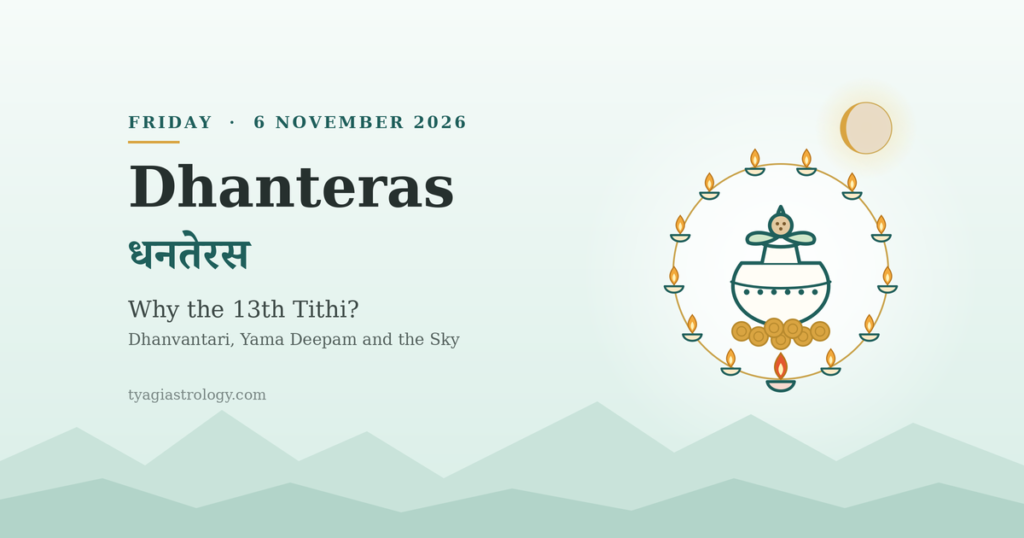
Ask most people what Dhanteras is, and they will say it is the day to buy gold. Ask an Ayurvedic physician, and they will say it is Dhanvantari Jayanti, the birthday of the god of medicine. Ask an elder in North India, and he may say it is the night of the Yama lamp, lit to keep the god of death away from the house. Three traditions, one tithi.
I went looking for what ties them together. The answer is not gold. It is the thirteenth tithi itself, and, as it turns out, what the Moon is doing in the sky while the festival unfolds.
| Date | Friday, 6 November 2026 (Kartik Krishna Trayodashi in Purnimanta calendars; Ashwin Krishna Trayodashi in Amanta calendars) |
| Trayodashi tithi | From 10:30 AM on 6 November to 10:47 AM on 7 November (Drik Panchang; my calculation gives 10:31 AM and 10:49 AM) |
| Puja muhurat, Delhi | About 6:02 to 7:57 PM (Pradosh Kaal with Vrishabha lagna, per Drik Panchang) |
| Yama Deepam | After sunset, in Pradosh Kaal (Delhi sunset about 5:29 PM) |
| The Moon | Sets at 3:32 PM; not in the evening sky. Rises at 4:41 AM on 7 November as a 6 percent crescent. In Hasta nakshatra through the evening |
| Also that evening | Pradosh Vrat (Shiva), which falls on every Trayodashi evening; this year on a Friday |
Times are for New Delhi and vary by city. Please check your own city’s panchang for the muhurat window.
A festival with three stories, and each equally important
Even the name hides the puzzle. Dhan means wealth and teras is the everyday word for thirteen, the thirteenth tithi, Trayodashi. There is no good philological basis for deriving Dhanteras from Dhanvantari. Teras belongs to the normal vernacular history of trayodaśī, while Dhanvantari retains a distinct stem; Nābhādāsa even attests Dhanvantar. The day is now known through several overlapping names and observances—Dhana-trayodaśī/Dhanteras, Yama-dīpa, and Dhanvantari Jayantī—but their textual histories are not identical. The late nineteenth-century evidence clearly treats Dhana-trayodaśī as a wealth observance. The Jain tradition keeps the day as Dhanya Teras, remembering Mahavira going into deep meditation shortly before his nirvana. The thread running through all of them is the tithi, not the gold.
The rule that decides the day
At sunrise on 6 November it is still Dwadashi. Trayodashi begins only at 10:30 in the morning and ends at 10:47 the next morning. So if the festival followed the sunrise tithi, the day would be unclear. It does not. The rule for this vow is Trayodashi at pradosh, the early evening after sunset, the time for the lamp and the puja. At pradosh on 6 November the tithi is Trayodashi, and at pradosh on 7 November it is already Chaturdashi. So the day is 6 November.
Notice how each vow carries its own time of day. Karwa Chauth is decided by moonrise, and Sharad Purnima by midnight. Dhanteras is decided by pradosh, and the puja itself is timed to the part of pradosh when a fixed sign, Vrishabha, is rising. For Delhi that window is about 6:02 to 7:57 PM. The five days of Diwali are fixed by several different hours of the day.
The strongest evidence-based description of Dhan Trayodashi or Dhan Teras
Trayodashi gives three clues. First, the tithi class. The tithis repeat in five types, and Trayodashi (3, 8, 13) is a Jaya tithi, the victorious one. Second, in the commonly cited list of tithi deities, Trayodashi belongs to Kama, the god of desire, and the lists vary. Third, every Trayodashi evening is Pradosh Vrat, the vow to Shiva at twilight. This year, because Dhanteras falls on a Friday, it is also a Friday pradosh. The tithi is not neutral. It is one of the monthly hours of Shiva.
The most important clue is a verse. The Yama lamp is offered with a verse attributed to the Skanda Purana, and it names the tithi in so many words. In the accessible Skanda Purāṇa, Vaiṣṇava-khaṇḍa, Kārttika-māhātmya 2.4.9.20, the prescription is direct:
आश्विनस्याऽसिते पक्षे त्रयोदश्यां निशामुखे ।
यमदीपं बलिं दद्यादपमृत्युर्विनश्यति ॥
āśvinasyāsite pakṣe trayodaśyāṃ niśāmukhe |
yamadīpaṃ baliṃ dadyād apamṛtyur vinaśyati ||
“On the dark Trayodaśī of Aśvina, at the beginning of night, one should offer a lamp to Yama; untimely death is destroyed.”
The following verses place the lamp at the house door and give a mantra. In the same recension:
मृत्युना पाशदण्डाभ्यां कालेन च मया सह ।
त्रयोदश्यां दीपदानात् सूर्यजः प्रीयतामिति ॥
mṛtyunā pāśadaṇḍābhyāṃ kālena ca mayā saha |
trayodaśyāṃ dīpadānāt sūryajaḥ prīyatām iti ||
“Through the gift of a lamp on Trayodaśī, may the son of the Sun be pleased…”
The Padma Purāṇa preserves a closely related rule:कार्तिकस्यासिते पक्षे त्रयोदश्यां …
यमदीपं बहिर्दद्यादपमृत्युर्विनश्यति ॥
kārtikasyāsite pakṣe trayodaśyāṃ …
yamadīpaṃ bahir dadyād apamṛtyur vinaśyati ||
“On the dark Trayodaśī of Kārttika one should place a lamp outside for Yama; untimely death is destroyed.”:
The tithi is in the text, so it was not chosen by accident. And the oldest layer of the festival I could find is not a purchase. It is a lamp. On Dhanteras evening, thirteen lamps are lit, one for each count of the tithi, and one is placed outside the house facing south. South is the direction of Yama, and a lamp is otherwise never set facing south. This one night is the exception. Yama is called sūryaja, the Sun’s son, which ties the lamp to the solar deities we met in the post on the twelve Adityas.
Dhanatrayodaśī, wealth and commerce
P. V. Kane describes the first day of the Dīpāvalī complex as involving worship of wealth and notes the name Dhanteras in Gujarat and Saurashtra; . He also describes household cleaning, decoration and the polishing of metal vessels. Rajbali Pandey is even more explicit. In the 1978 Hindū Dharmakośa, p. 337, the entry reads in substance:
धनत्रयोदशी कार्तिक कृष्ण त्रयोदशी का एक नाम।
dhanatrayodaśī kārtika kṛṣṇa trayodaśī kā eka nāma
“Dhanatrayodaśī is a name for Kārttika Kṛṣṇa Trayodaśī.” It then says merchants clean and arrange commercial goods, worship the deity of wealth, prepare old and new accounts, and regard new purchase and sale as auspicious. Immediately afterwards it states that this is also Dhanvantari’s birthday and that physicians celebrate Dhanvantari Jayantī.
An 1897 Indian Antiquary calendar notice explicitly lists:
“XIII.—Dhana-trayōdaśī, on which money-lenders and others worship money.” That is independent late nineteenth-century printed evidence for Dhana-trayodaśī as a wealth observance. Dhanatrayodaśī as an independently named wealth observance is securely nineteenth-century or earlier.
Dhanvantari: two births, one textbook
The Bhagavata Purana (8.8) and the Vishnu Purana (1.9) tell how Dhanvantari rose from the ocean of milk during the churning, holding the pot of amrita. Later tradition identifies this Trayodaśī as Dhanvantari Jayantī, although the Purāṇic churning passages themselves do not state the lunar date.
The medical and royal traditions identify Dhanvantari with the Kāśī lineage; Suśruta specifically addresses Divodāsa, king of Kāśī, as Dhanvantari, while Purāṇic genealogies vary in how Dhanvantari and Divodāsa are related. So Dhanvantari belongs to both a Purana and a textbook of surgery.
Dhanteras should not, however, be explained as a worn-down form of “Dhanvantari Trayodaśī.” Linguistically, Dhanteras is the vernacular counterpart of Dhana-trayodaśī—dhana, wealth, plus teras, the thirteenth lunar day—and nineteenth-century evidence already records Dhana-trayodaśī as a wealth observance. Dhanvantari Jayantī is an important tradition on the same tithi, especially among Ayurvedic physicians, but the Purāṇic accounts of Dhanvantari’s emergence do not themselves assign that event to Trayodaśī.
Modern historical work on colonial Ayurveda describes Dhanvantari Mahotsava as an organised professional celebration promoted by Ayurvedic associations and journals in the early twentieth century, especially the All India Vaidya Sammelan and its provincial networks.
The Bhāgavata Purāṇa unequivocally identifies the figure emerging with amṛta as Dhanvantari. At 8.8.35–36:
अमृतापूर्णकलसं बिभ्रद्…
धन्वन्तरिरिति ख्यात आयुर्वेददृगिज्यभाक् ॥
amṛtāpūrṇakalasaṃ bibhrad …
dhanvantarir iti khyāta āyurvedadṛg ijyabhāk ||
“Bearing a vessel filled with nectar … he became known as Dhanvantari, knower of Ayurveda…”
The Viṣṇu Purāṇa 1.9 similarly states:
ततो धन्वन्तरिर्देवः …
बिभ्रत्कमण्डलुं पूर्णममृतस्य समुत्थितः ॥
tato dhanvantarir devaḥ …
bibhrat kamaṇḍaluṃ pūrṇam amṛtasya samutthitaḥ ||
“Then the god Dhanvantari arose, bearing a vessel filled with nectar.” Neither of these passages says “this occurred on Kārttika Kṛṣṇa Trayodaśī.” A modern scholarly review of Dhanvantari festivals likewise notes that the old textual narratives about the various Dhanvantaris do not themselves supply festival dates.
However, the custom lives on in food. In Tamil households a medicinal preparation called marundhu is made around the eve of Naraka Chaturdashi, the Dhanvantari Trayodashi, and eaten to balance the doshas after the festival sweets. That fits the Ayurvedic season: as we saw in the Sharad Purnima post, autumn is the time of aggravated pitta.
One update for anyone quoting older articles. From 2016 to 2024 the government of India observed National Ayurveda Day on Dhanteras. A notification of March 2025 moved it to a fixed date, 23 September, so it no longer follows Dhanteras.
A note on consistency. Drik Panchang says Lakshmi emerged from the ocean on Dhantrayodashi. The Kojagara tradition places her emergence on Sharad Purnima. Traditions differ on which day of the churning each treasure appeared, and I would not force them into one timetable.
The lamp that faces south
The story everyone tells is of King Hima’s son. A horoscope said the sixteen-year-old would die of snakebite on the fourth night of his marriage. His young wife heaped her gold and silver at the door, lit lamps everywhere and kept him awake with songs and stories. Yama came as a snake, was dazzled, climbed onto the heap of coins and listened until dawn. I could not trace this story to a specific text, so I would present it as a popular legend. The Skanda Purana verse above is the part I could attribute.
Notice what the legend does. It explains the gold and the lamps in one image: wealth as protective light. It is also a vigil story, like Karwa Chauth and Kojagara, where a woman stays awake through a dangerous night. In Nepal, the same day opens Tihar with food left out for crows, messengers of Yama.
Gold, utensils and the text that is missing
I looked for a scriptural instruction to buy gold on Dhanteras and did not find one. The custom is explained by the Hima legend and by the image of Dhanvantari holding a vessel, so buying a new metal vessel is read as welcoming the pot of nectar. Those are popular explanations, not texts. That does not make the custom meaningless, only more recent and more social than most people assume.
A practical note, not financial advice. If you buy gold, look for the BIS hallmark with its HUID, and avoid borrowing to buy it. A small, real purchase, a utensil or a coin, honours the custom as well as a large one.
The sky on Dhanteras evening
This is what I calculated for the evening of 6 November. The Sun is in Tula (Swati), still in its sign of debilitation. The Moon is in Kanya, in Hasta nakshatra, which runs from about 3:55 AM on 6 November to about 4:42 AM on 7 November. Jupiter has just moved into Simha. Venus is retrograde in Kanya, roughly 20 degrees behind the Sun, so it is not combust. Venus turns direct on 14 November.
Hasta is worth noting. The muhurta texts group Ashwini, Pushya and Hasta as the Kshipra, or swift, nakshatras, favourable for trade, purchases and travel. Hasta’s deity is Savitr, a solar deity counted among the Adityas in some lists. The sky and the custom happen to agree this year. Please confirm the nakshatra timing in your own panchang.
The five days follow the Moon out and back
Here is something I noticed when I calculated the sky for these nights, and it is my own observation, not something a text says. Diwali’s five days run from Trayodashi to Dwitiya, across the new Moon. They therefore trace the Moon’s disappearance and return.
| Date (2026) | Observance | Before sunrise | After sunset |
| 6 Nov | Dhanteras (Trayodashi) | 11% lit, 29° up | Below horizon |
| 7 Nov | Naraka Chaturdashi (some calendars) | 5% lit, 17° up | Below horizon |
| 8 Nov | Diwali (Amavasya) | 2% lit, 6° up | Below horizon |
| 9 Nov | New Moon at 12:32 PM | Below horizon | Below horizon |
| 10 Nov | Govardhan Puja | Below horizon | 1.6% lit, on the horizon |
| 11 Nov | Bhai Dooj (Dwitiya) | Below horizon | 5% lit, 7° up |
| 12 Nov | Dwitiya ends; Tritiya | Below horizon | 10% lit, 15° up |
My own calculation for Delhi, taken 30 minutes before sunrise and 30 minutes after sunset. Visibility depends on sky conditions.
On Dhanteras the Moon is a thin crescent in the pre-dawn sky. By Diwali morning it is a 2 percent sliver barely above the horizon. After the new Moon it first returns to the evening sky on 11 November, which is Bhai Dooj. The festival of lamps starts when the Moon is almost gone and ends when it first reappears. I would read that as a quiet explanation for why light is the whole point.
Vedic Astrology and Dhanteras: what astrologers say
As before, I will separate the classical from the popular. The classical Jyotisha for a day like this is about timing and houses. The puja is set in pradosh with a fixed lagna. Wealth in a birth chart is read from the second and eleventh houses, their lords and the periods running. And, notably, the classical dhana-karaka, the significator of wealth, is Jupiter, not Venus.
The popular view. Many astrologers link Lakshmi with Venus, Kubera with Mercury or Jupiter, gold with Jupiter, silver with the Moon or Venus, and brass with Mercury. Some link the Yama lamp with Saturn, because Yama and Shani are both sons of Surya in the Puranic genealogy. Many also warn against buying jewellery while Venus is retrograde, which it is until 14 November.
The reasoning, and my caution. The links are thematic. Venus stands for comfort and luxury, Jupiter for prosperity, Saturn for endings. I would be careful with the Venus warning. The classical muhurta restrictions I know of concern the combustion (asta) of Venus and Jupiter, not retrogression, and neither is combust this year. These are popular opinions, and I treat them as symbolism.
What I find more convincing is the order of the three owners of the day: Dhanvantari, then Yama, then Lakshmi. Health first, then life itself, then wealth. An old proverb says the same, that the first happiness is a healthy body and the second is wealth in the house. Dhanteras seems to be the one festival that states the priority in the right order.
A simple way to keep the evening
Clean and clear the house in the afternoon. After sunset, light the thirteen lamps, placing one outside facing south. Do the Lakshmi and Kubera puja in the muhurat window for your city, with a prayer to Dhanvantari for health. Buy something small and real if you like, and eat lightly. And look for the Moon before dawn, because the thin crescent is on its way out. In a place like Delhi, this might be difficult considering the pollution levels at this time of the year, but nevertheless, do try.
Ask Fearlessly. Decide Wisely.
‘Aryaman’ Saurabh Tyagi
Jyotiṣī with specialization in Jātaka and Muhūrta | Birth Chart Analyst