What Do the Nine Nights Really Mean?
Sharad Navratri 2026 | 11 to 19 October
On Sunday, 11 October 2026, Sharad Navratri begins. The previous night’s Amavasya closes Pitru Paksha, and with the first tithi of the bright fortnight of Ashwin, the nine nights of Devi worship open. The festival runs through to Vijayadashami on Tuesday, 20 October.
Much of what circulates online about Navratri is colours, fasting menus and a remedy for every zodiac sign. I would rather start with a more basic question. Why these nine nights, and what does Jyotisha actually have to do with them?
| Begins | Sunday, 11 October 2026 (Ashwin Shukla Pratipada) |
| Vijayadashami | Tuesday, 20 October 2026 |
| Pratipada, New Delhi | Present at sunrise (about 6:19 AM) and continuing until about 9:30 PM |
| Moon | In Chitra Nakshatra, beginning in Kanya; Vaidhriti Yoga also present |
| Ghatasthapana | Morning window about 6:19 to 10:12 AM; Abhijit Muhurta about 11:44 AM to 12:30 PM |
| Tula Sankranti | Around 17 October, within the nine nights |
Timings are for New Delhi. Panchang sources and family traditions differ slightly, so please confirm locally.
The central text of Devi worship is the Devī Māhātmya, chapters 81 to 93 of the Mārkaṇḍeya Purāṇa. It opens with Mahāmāyā, the power by which the universe is held and by which even the wise are bound. When Mahiṣāsura defeats the gods, they cannot recover by acting separately. Their individual energies (tejas) are gathered into a single radiance, and the Goddess appears from it.
You can read this devotionally, as the Purāṇa intends. You can also read it as a description of ordinary life. A person may have intelligence, courage, resources and learning, and still be ineffective, because fear, attachment, anger or confusion keeps those faculties from working together. Navratri is a season for collecting what has been scattered.
The Devī Bhāgavata Purāṇa treats the observance directly. Book III, chapter 26 describes the Navarātra vrata and names the two seasons for it, spring and autumn, the months of Chaitra and Ashwin. These are still the two principal Navratris today. The text also treats these as seasons of change when illness and disturbance are more likely, which suits a practice of restraint, fasting and regular worship.
Rama and the autumn worship
In Book III, chapter 30, the same Purāṇa tells of Rama after Sita’s abduction. Nārada advises him to worship the Goddess through the nine nights of Ashwin. Rama observes the vrata, performs worship and homa, and the Devi appears to him before the campaign against Ravana.
A related tradition exists in Bengal. Retellings such as the Krittivasi Ramayana describe Rama invoking Durga out of season (akāl bodhan), which is how Bengali Durga Puja came to be placed in autumn. This does not appear in Vālmīki’s Ramayana, so it should be cited as a Purāṇic and regional tradition, not as part of the epic.
Either way, the sequence is the same. Rama does not begin with the battle. He begins with an inner act of alignment, and then the battle.
Where Jyotisha enters
Jyotisha enters Navratri in a more basic way than most articles suggest. Navratri is a calendrical observance. It is fixed by tithi, nakshatra, yoga and sunrise, the elements of the Panchang. When it begins, when the Kalash may be installed, and which windows are best avoided are all questions of Jyotisha.
This year the details are specific. At sunrise in New Delhi, around 6:19 AM, Shukla Pratipada is already running and continues until roughly 9:30 PM, so Ghatasthapana is done on 11 October. The Moon is in Chitra Nakshatra, beginning in Kanya, and Vaidhriti Yoga is also present. Many panchang traditions avoid both for starting the Kalash rite, and those who follow this rule often choose the Abhijit Muhurta around midday. Families and priests differ on this, so it is sensible to confirm with your own tradition.
There is also a solar point. The Sun is in Kanya as Navratri begins and enters Tula (sidereal Libra) around 17 October, within the nine nights. Tula is the sign of the Sun’s debilitation. I would not turn this into a prediction for each sign, but it is worth noting for anyone who follows the seasonal movement of the calendar.
The Navadurga and the Navagrahas
Many modern articles link the nine forms of Durga to the nine planets: Shailaputri with the Moon, Brahmacharini with Mars, Chandraghanta with Venus, Kushmanda with the Sun, Skandamata with Mercury, Katyayani with Jupiter, Kalaratri with Saturn, Mahagauri with Rahu and Siddhidatri with Ketu.
This is a popular scheme, but it is not stated in the Purāṇas, and different Jyotisha lineages assign the correspondences differently. The traditional list of the nine forms comes from the Devī Kavacha, traditionally recited alongside the Devī Māhātmya and presented as the words of Brahmā to the sage Mārkaṇḍeya. The planetary assignments should be read as a later interpretive layer.
The first night: Śailaputrī, daughter of the mountain
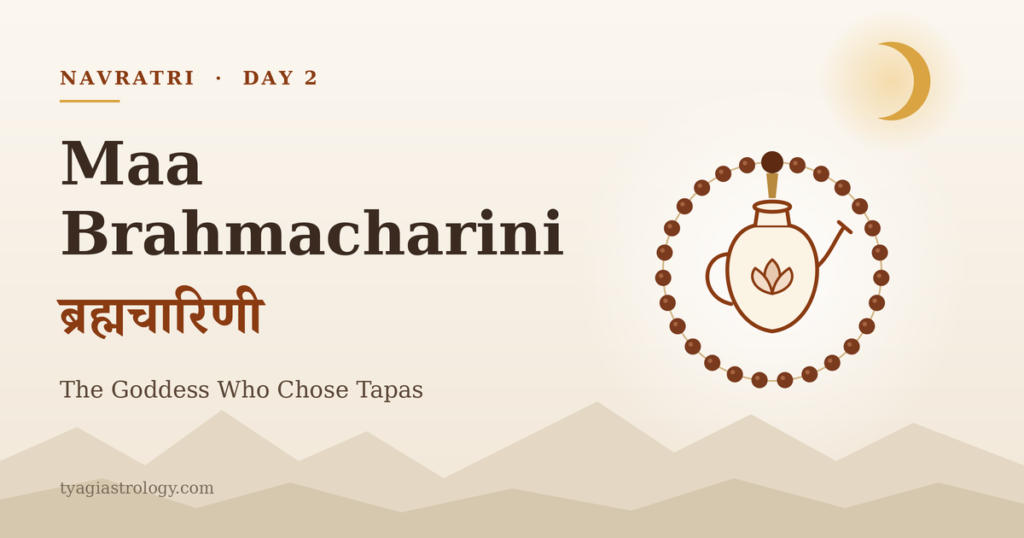
The first of the nine nights belongs to Śailaputrī. The name is simple Sanskrit: śaila is mountain and putrī is daughter. She is the daughter of Himavān, the Himalaya, and the name points to Pārvatī. The Himalayan connection runs through several layers of the tradition.
What the texts say
The Navadurga list. The order of the nine Durgas that Navratri follows comes from the Devī Kavacha. In verses 3 to 5, Brahmā names them, and the first is Śailaputrī. The Kavacha is traditionally recited with the Saptashati but is not part of the Devī Māhātmya proper, so it is a different text from the one that tells the story of Mahiṣāsura.
prathamaṃ śailaputrīti dvītiyaṃ brahmacāriṇī |
tṛtīyaṃ candraghaṇṭeti kūṣmāṇḍeti caturthakam ||
The name in earlier literature. “Śailaputrī” and “Haimavatī” (daughter of Himavān) are old names for Pārvatī. A note on the Navadurga names reports that Śailaputrī is used for her in the Vālmīki Rāmāyaṇa, in the Bāla Kāṇḍa (cited as 1.36.27). The epic’s account of Himavān’s two daughters is in that part of the text.
The Upaniṣad. The earliest textual layer is the Kena Upaniṣad. After the gods win a victory and grow proud, a mysterious Yaṅṣa appears. Agni and Vāyu cannot understand it. Indra then sees the Yaṅṣa vanish and meets a radiant woman, Umā Haimavatī, who teaches him that the victory belonged to Brahman alone. In continuous numbering this is verse 12, which some editions mark 3.12 or 4.1. It is the Upaniṣadic root of the idea that the Goddess as Himavān’s daughter is also the bearer of wisdom.
The Purāṇic story. Pārvatī’s birth to Himavān and Menā is told in the Purāṇas, including the Śiva Purāṇa and the Devī Bhāgavata. In the standard account she was Satī, daughter of Dakṣa, in her previous birth, and she returns as the mountain’s daughter to be reunited with Śiva.
What later devotional literature adds
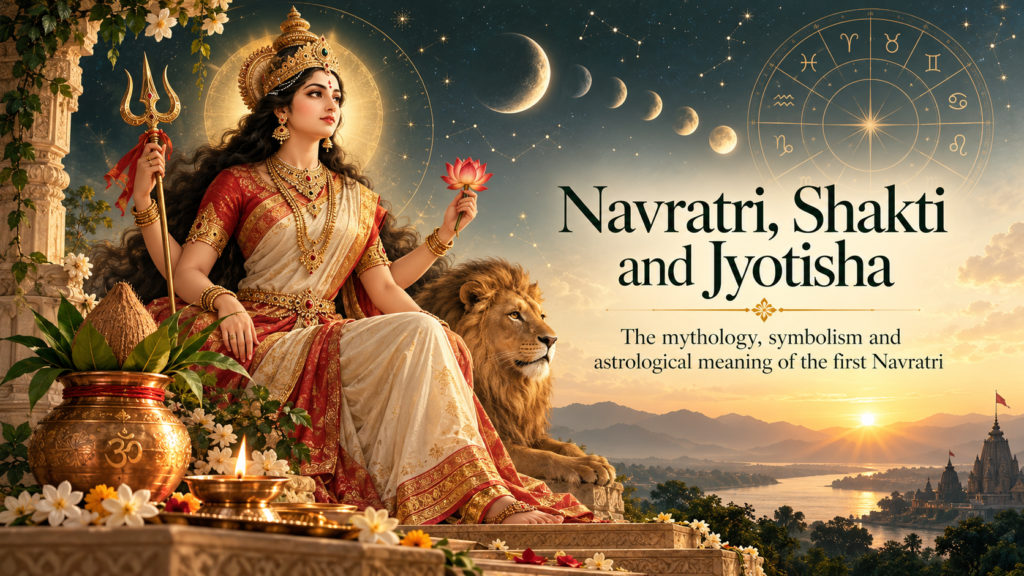
The iconography belongs to this later layer. Śailaputrī is shown with two arms, a trident in the right hand and a lotus in the left, seated on the bull Nandi (vṛṣārūḍhā), with a crescent moon on her head. A widely used dhyāna verse from the Navadurga stotra describes her this way:
vande vāñchitalābhāya candrārdhakṛtaśekharām |
vṛṣārūḍhāṃ śūladharāṃ śailaputrīṃ yaśasvinīm ||
In plain words: I bow to her for the fulfilment of my wishes. She is crowned with the crescent moon, rides the bull, bears the trident, and is the glorious daughter of the mountain.
The common mantra is Oṃ Devī Śailaputryai Namaḥ. The popular verse beginning yā devī sarvabhūteṣu is an adaptation. The underlying hymn is from chapter 5 of the Devī Māhātmya, and the substitution of her name for the generic form is a later liturgical practice, not original Purāṇic text.
Many writers on Navratri link Śailaputrī with the mūlādhāra chakra, the root centre at the base of the spine, as the foundation of the practice. This is a Tantric and yogic reading developed later. It is useful as symbolism but is not stated in the Purāṇas.
Why the Moon
In the popular Navadurga-to-planet scheme, Śailaputrī is linked with the Moon (Chandra). Many devotional and astrological writers describe worship of her as a way to ease difficult Moon placements in a chart. In Jyotisha the Moon stands for the mind (manas), emotions, intuition and one’s sense of security.
My own reading, which is an interpretation and not something the texts say, is that the iconography likely drove the association. She wears the crescent moon on her head, and she is worshipped on Pratipada, the first tithi of the waxing Moon. Her day begins at the point where the Moon’s light is just returning.
This should be presented as a popular scheme and not an ancient rule. The caution that applies to the whole Navadurga-Navagraha table applies here as well. It is a devotional belief, not a guaranteed astrological remedy.
Grounding before ascent
Before ascent comes grounding. Before achievement comes stability. Navratri begins just after the dark Moon, when the Moon has vanished and starts to wax again, so the nine nights open with a first thin edge of light that grows with each night. That is a fitting beginning for a festival that asks us to build slowly and from the base.
A better question
People usually come to astrology when something is already uncertain, such as work, marriage, money, health or direction. Astrology should not leave a person more afraid of planets. Worship should not become a transaction in which we please a deity so that a difficult planet will behave.
Navratri suggests another approach. Notice what keeps defeating you. Name it, whether it is fear, anger, attachment, indecision or inertia. Then bring discipline and devotion to it, night after night. The chart can show a pattern, but recognising it is a personal task, and Shakti is the strength to work through it.
So this Navratri, instead of only asking “What will happen to me?”, consider asking “What in me needs to change?”
Ask Fearlessly. Decide Wisely.
Saurabh Tyagi
Vedic Astrology Consultant
Sources and notes
- Mārkaṇḍeya Purāṇa, Devī Māhātmya (chapters 81 to 93).
- Devī Bhāgavata Purāṇa, Book III, chapters 25, 26 and 30.
- Devī Kavacha, verses 3 to 5 (list of the Navadurga), traditionally recited with the Devī Māhātmya.
- Kena Upaniṣad, the Umā Haimavatī passage (verse 12 in continuous numbering).
- Vālmīki Rāmāyaṇa, Bāla Kāṇḍa, on Himavān’s daughters.
- Navadurga stotra (dhyāna verse for Śailaputrī); Devī Māhātmya, chapter 5 (hymn “yā devī sarvabhūteṣu”).
- Regional tradition: Krittivasi Ramayana (akāl bodhan).
- Panchang timings are for New Delhi, compiled from published Panchang sources, and should be checked against your preferred Panchang. Navadurga-Navagraha correspondences, chakra associations and iconography are treated as later devotional and astrological interpretations, not Purāṇic doctrine.