
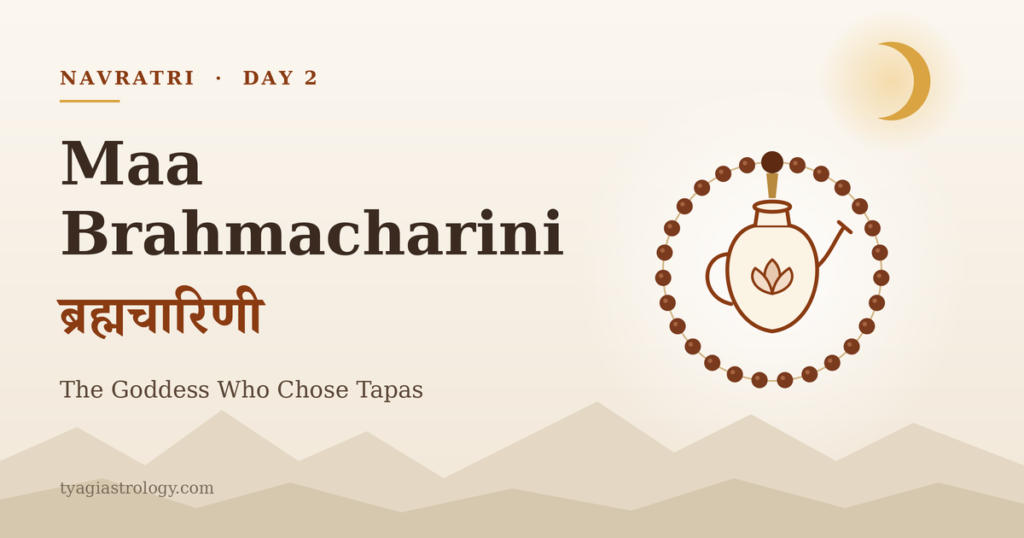

Maa Brahmacharini
The Goddess Who Chose Tapas
Navratri Day 2 | Mythology, Tantra, Geography and Vedic Astrology
On Monday, 12 October 2026, the second night of Sharad Navratri belongs to Maa Brahmacharini. The day falls on Ashwin Shukla Dwitiya, and it coincides with Chandra Darshana, the first sighting of the new crescent after Amavasya. The goddess of the second night and the Moon of the second night make the same quiet point: a very thin beginning is not a small one.
Yesterday gave us Shailaputri, the mountain-born daughter. Today the same young woman makes a choice. Brahmacharini is Pārvatī in the years of her austerity. She holds no weapon. Her hands carry a rosary and a water pot, and her story is among the best documented in the Navadurga tradition, because it appears in the Purāṇas and in the poetry of Kālidāsa.
| Date | Monday, 12 October 2026 (Ashwin Shukla Dwitiya) |
| Tithi | Dwitiya until about 10:13 PM IST, according to one published panchang |
| Also today | Chandra Darshana, the first sighting of the new crescent |
| Iconography | White attire, rosary (japamala) in the right hand, water pot (kamandalu) in the left |
| Chakra | Svadhishthana, as named in the traditional dhyana verse |
| Popular planet link | Mars (Mangala) in popular astrology; sources differ |
Timings are for India. Please confirm locally with your own panchang.
Who is Brahmacharini?
The name joins brahman with the root char, which means to move, to practise, to be absorbed in. In Sanskrit brahman carries several senses: the Veda, the Absolute, and tapas, austerity. So the name does not simply mean an unmarried girl. It can mean she whose nature is absorbed in Brahman, or she who is devoted to austerity.
The Pradīpa, a commentary on the Devī Kavacha by Maheśa Ṭhakkura, adds a third sense: she who leads others to Brahman. A verse attributed to the Devī Purāṇa and cited in the Śabdakalpadruma explains the name as one who dwells in the Vedas. In the Lalitā Sahasranāma the name Brahmarūpā (name 265) calls the Goddess Brahman itself.
The nine names that Navratri follows come from the Devī Kavacha, where Brahmā tells Mārkaṇḍeya the list. Brahmacharini is second:
prathamaṃ śailaputrīti dvitīyaṃ brahmacāriṇī |
Her traditional invocation describes her two hands:
dadhānā karapadmābhyām akṣamālā-kamaṇḍalū |
devī prasīdatu mayi brahmacāriṇyanuttamā ||
दधाना करपद्माभ्यामक्षमालाकमण्डलू ।
देवी प्रसीदतु मयि ब्रह्मचारिण्यनुत्तमा ॥ १ ॥
दधाना (dadhānā) – bearing, holding; करपद्माभ्याम् (karapadmābhyām) – with her two lotus-like hands (kara:hand | padmābhyām:with the two lotuses); अक्षमाला-कमण्डलू (akṣamālā-kamaṇḍalū) – a rosary of beads and a water-pot (akṣamālā:rosary of beads | kamaṇḍalu:ascetic’s water-pot); देवी (devī) – the Goddess; प्रसीदतु (prasīdatu) – may she be gracious, may she be pleased; मयि (mayi) – upon me, towards me; ब्रह्मचारिणी (brahmacāriṇī) – she who moves in the Absolute, the celibate ascetic (brahma:the Absolute, sacred knowledge | cāriṇī:she who moves/practices); अनुत्तमा (anuttamā) – the supreme, the unsurpassed (an:not | uttamā:surpassable);
In plain words: holding a rosary and a water pot in her lotus hands, may the supreme Brahmacharini be gracious to me.
ॐ देवी ब्रह्मचारिण्यै नमः ॥
Om. Salutations to the Goddess Brahmacāriṇī, she who treads the path of sacred discipline and the pursuit of the Supreme Reality.
ॐ (oṃ) – Om, the primordial sound; देवी (devī) – the Goddess; ब्रह्मचारिण्यै (brahmacāriṇyai) – to Brahmacāriṇī, she who moves in the pursuit of Brahman / practices sacred austerity (brahma:the Supreme Reality | cāriṇyai:to her who moves in / practices); नमः (namaḥ) – salutations;
The story of her tapas
The background comes from the Pārvatī story. After Satī gives up her life, Śiva withdraws into meditation. The demon Tārakāsura can be killed only by a son of Śiva, so the gods send Kāma to stir Śiva’s heart. Śiva burns Kāma to ashes in front of Pārvatī. In Kālidāsa’s Kumārasambhava, Canto 5, her beauty has failed, and she decides to win Śiva by penance. The commentator Mallinātha observes that what beauty cannot accomplish, tapas can.
Her mother Menā tried to stop her. According to Kālidāsa (Kumārasambhava 1.26), she said u mā, meaning “O, don’t”, and that is how Pārvatī received the name Umā. The Śiva Purāṇa also traces the name to Menā’s reluctance.
The austerities were severe. In summer she sat among five fires with the Sun as the fifth. In the rains she took no shelter. She first lived on fruits, then only on leaves that had fallen on their own, and finally gave up even those. For this the gods named her Aparṇā, she who did not even take a leaf (Kumārasambhava 5.28; Śiva Purāṇa, Rudra Saṃhitā, Pārvatī Khaṇḍa 2.3.22). Accounts differ on how long it lasted, but all describe a period of thousands of years.
Her tapas had cosmic effect. In the Śiva Purāṇa it distressed all beings and the gods went to Śiva to ask that he accept her. Śiva first sent the Saptarṣis to test her. Then he came himself, disguised as a young ascetic, and spoke against Śiva to see how she would respond. She rebuked the stranger, and at that point Śiva revealed himself.
Tantric and devotional layers
The traditional dhyāna verse for the day places Brahmacharini in the Svādhiṣṭhāna chakra. In the yogic scheme Svādhiṣṭhāna is the second chakra and is associated with water. This is a Tantric and yogic layer that developed later. It is not stated in the Purāṇas.
Tantric geography also meets her story in Kāñcī. The Pīṭha Nirṇaya Tantra identifies Kāñcī as a Śakti Pīṭha, and the local tradition places Pārvatī’s penance at the Ekāmbareśvara temple there (see below).
History and literature
The earliest great literary account is Kālidāsa’s Kumārasambhava. Kālidāsa is generally placed in the Gupta period, though the exact dating is debated. The Devī Māhātmya is usually dated to around the fifth or sixth century CE, and the Devī Kavacha is traditionally recited alongside it, although it is not part of it. The Śiva Purāṇa gives the fuller devotional telling.
The sequence of nine forms is also not universal. In the South Indian Navadevi tradition, for example, the Vijayawada Kanaka Durga temple adorns the Goddess as Gāyatrī Devī on the second day. Many families follow the Navadurga order and colour calendars, which also vary from year to year.
Where her tapas is remembered
Himalaya. The Śiva Purāṇa places her penance at Śṛṅgī Tīrtha, later known as Gaurī Śikhara. In Uttarakhand, Gaurikund, the road-head for Kedarnath, is popularly linked with her austerities. That is a local tradition.
Kashi. The Navadurga yatra in Varanasi visits a Brahmacharini temple on the second day. It is listed near Brahma Ghat and Panchganga Ghat (Ghasi Tola); listings differ on the exact lane.
Kanchipuram. At the Ekambareswarar temple the tradition says Pārvatī, as Kāmākṣī, made a lingam of earth under a mango tree. When the Vegavati river flooded, she embraced the lingam to protect it. The episode is described in the Kanchi Puranam and the Tirukkurippu Thondar Puranam.
Mangadu, near Chennai. The Tapas Kamakshi temple remembers the Goddess in penance among five fires, with a rosary held up in her hand.
Nepal. In Dashain the second day is observed with Brahmacharini worship at the household Dashain Ghar.
Six things most people overlook
- The brahmachari in the story is Shiva. In Canto 5 of the Kumārasambhava and in the Śiva Purāṇa, the young ascetic who tests her is Śiva himself. The Brahmacharini is tested by a disguised Brahmachari.
- Three of her famous names come from this one chapter of her life. Brahmacharini, Umā and Aparṇā are all names that arise in the story of her penance.
- She holds no weapon. Her iconography is made of the tools of an ascetic: a rosary and a water pot. In a festival about the Goddess as warrior, this is deliberate.
- Beauty failed first. She turned to tapas only after Kāma’s arrow and her own beauty did not move Śiva. The story treats tapas as a deeper power than attractiveness.
- Brahmacharya is not a rejection of marriage in Vedic usage. The Atharva Veda (11.5.18) says a maiden wins a young husband through brahmacharya. Her austerity is a path to union, not away from it.
- Day 2 leads to Day 5. In story order her penance is what makes the birth of Kārtikeya possible, and Kārtikeya’s mother is Skandamātā, worshipped on the fifth night.
Vedic Astrology and Maa Brahmacharini: What astrologers say
A note before this section. The classical texts of Vedic Astrology do not assign the Navadurga to planets. What follows is the popular opinion among astrologers and Navratri guides. It is included because readers of astrology and Navratri content often look for it, and because there is some interesting reasoning behind it. It is not scriptural.
The popular view: Mars. In the widely circulated scheme, Brahmacharini is linked with Mars (Mangala). Some astrology portals recommend worship on the second day for people with difficult Mars placements or Mangal Dosha, suggesting red flowers and sugar. The sources are not unanimous. Some reference works list Ketu for Brahmacharini, and the lists differ elsewhere as well.
The reasoning behind the Mars view. Four ideas are usually offered. First, Mars is the planet of fire, effort and endurance in Vedic Astrology, and tapas literally means heat. Second, her penance is energy under discipline, which is how many astrologers describe the best use of Mars. Third, her tapas leads to the birth of Kārtikeya, the war-commander, whom popular devotion, especially in South India, associates with Mars. Classical lists of presiding deities for the planets differ on this. Fourth, Hanuman, another figure of strict celibacy and strength, is also commonly linked with Mars.
The reasoning behind the Ketu view. Ketu stands for detachment, withdrawal and liberation. A goddess shown renouncing comfort and wandering in a forest suits that symbolism, which is why some lists prefer it.
Why it should be read as symbolism. Nothing in the Purāṇas makes the connection. The scheme follows the fixed order of the nine nights, not the weekday, which is why this year Day 2 falls on a Monday and Mars’s day is Tuesday. And since the lists conflict, none of them can claim to be the rule. In honest Vedic Astrology, a chart describes patterns of timing and temperament. A deity is not a remedy for a planet, and worship does not need a planetary reason to be worth doing.
Where astrology and Navratri meet most usefully is not in a table of planets but in a shared idea: time rewards patient, disciplined effort. The crescent sighted today is thin and easy to miss. Brahmacharini does her best work in a forest, without an audience, long before anyone sees the result. Perhaps the question for the second night is a quiet one. What are you willing to practise, steadily, before it shows?
Ask Fearlessly. Decide Wisely.
Saurabh Tyagi
Certified Vedic Astrology Consultant
Sources and notes
- Devī Kavacha, verses 3 to 5 (Navadurga list), with the Pradīpa commentary of Maheśa Ṭhakkura; see also Nityanand Misra’s Swarajya article on the nine names of Durga.
- Kālidāsa, Kumārasambhava: 1.26 (Umā), Canto 5 (penance, Aparṇā at 5.28, the disguised ascetic).
- Śiva Purāṇa, Rudra Saṃhitā, Pārvatī Khaṇḍa (the penance chapters, Aparṇā at 2.3.22).
- Lalitā Sahasranāma, name 265 (Brahmarūpā).
- Pīṭha Nirṇaya Tantra (Kāñcī as a Śakti Pīṭha); Kanchi Puranam and Tirukkurippu Thondar Puranam (Ekambareswarar legend).
- Atharva Veda 11.5.18 (brahmacharya and marriage). Please verify the verse number and wording in your edition before quoting.
- Gaurikund as a site of her austerities, the Kashi temple location, and the Navadevi sequence are local or regional traditions and vary by source.
- The Mars and Ketu associations, the chakra assignment and the colour of the day are later devotional and astrological interpretations. They are not Purāṇic doctrine.