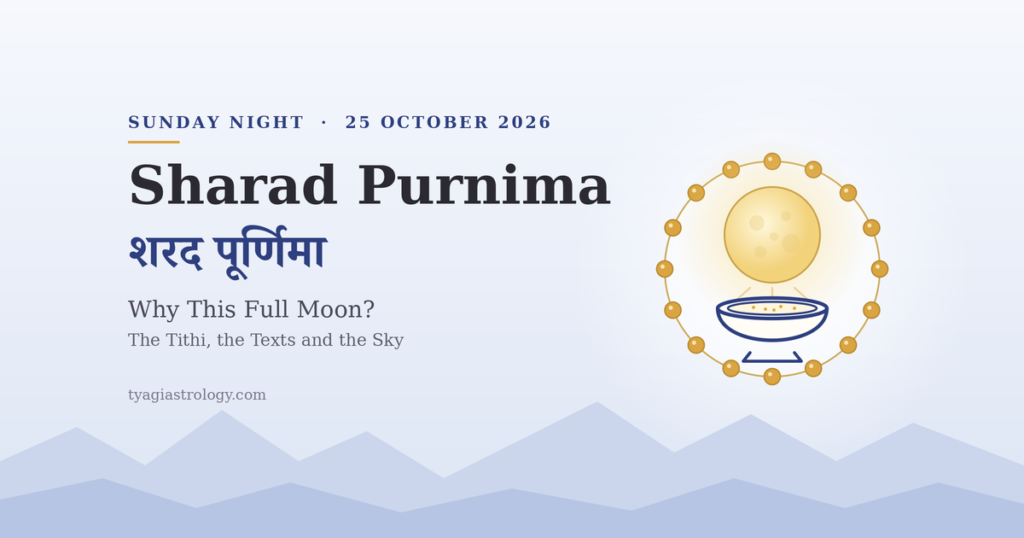
Tonight the Moon rises in Delhi at about 4:55 PM, before the Sun has set, and it stays up until 6:27 tomorrow morning. Across India families will cook milk and rice, set the bowl out in the moonlight and stay awake. Rooftops in Bengal will wait for Lakshmi’s question, ko jagarti, “Who is awake?”. In Vrindavan the temples will be dressed in white for the night of the Raas.
There are twelve or thirteen full Moons every year. Why does this one get a whole tradition? I went looking for the reasons. Some of the answers are in the texts, some are in the sky, and one popular belief about tonight turns out not to be true.
| The night | Sunday night, 25 October 2026 (some calendars date it Monday, 26 October) |
| Purnima tithi | From 11:55 AM on 25 October to 9:41 AM on 26 October (Drik Panchang, Delhi) |
| Full Moon | Exactly at about 9:41 AM IST on 26 October (my calculation) |
| Moon, Delhi | Rises about 4:55 PM, before sunset (5:42 PM); sets about 6:27 AM |
| At midnight | Moon in Mesha, Ashwini nakshatra; Sun in Tula, Swati (sidereal, Lahiri) |
| Other names | Kojagari (Bengal), Raas Purnima (Braj), Kumar Purnima (Odisha), Navanna Purnima, Kaumudi Purnima |
Times are for New Delhi. Please check your own city’s panchang for moonrise and the midnight (Nishita) window.
The rule that decides the night
Start with a puzzle. The Purnima tithi ends at 9:41 on Monday morning, so some calendars print 26 October. Yet the festival is kept tonight. Why?
Every vow carries its own time-of-day rule, and the rule tells you what the festival is really about. Karwa Chauth is decided by moonrise, because the vow ends with the Moon. Ganesh Chaturthi is decided by midday, because Ganesha is said to have been born at midday. Kojagara, the Lakshmi vow of Sharad Purnima, is decided by Nishita, the middle of the night. The day that counts is the one on which Purnima is present at midnight (nishitha-vyāpinī), and the Dharmasindhu’s tie-breaking rules settle the cases where a tithi spans two dates. Purnima is present at midnight tonight, so the night is tonight.
Notice the meaning of that rule. This is a festival of the night itself, of staying awake while the Moon is high, not of a day.
The Ayurvedic logic of the kheer
Why milk, rice and sugar? Ayurveda has an answer. Sharad, the autumn of Ashwin and Kartik, is described as the season in which pitta is aggravated. The monsoon has just ended, and the sudden return of the hot sun provokes the heat that accumulated during the rains. The classical regimen for the season, described in the Charaka Samhita and in Vagbhata’s Ashtanga Hridaya, favours sweet, bitter and astringent tastes, rice, ghee and sugar, and avoids sour, pungent and heating foods. Sugar is even named as the traditional accompaniment for the season’s ritu haritaki. Kheer is, in effect, the season’s textbook food.
The Moon is part of the regimen too. The texts praise hamsodaka, water that has been heated by the sun by day, cooled by the moon at night, and purified by the rising of the star Agastya (Canopus), and they recommend enjoying moonlight in the evenings of Sharad. The kheer in the moonlight looks like a folk compression of that autumn regimen onto its most luminous night. I would add the Tantric and devotional belief that the Moon’s rays drip nectar on this night. That is the tradition’s belief, and I cannot say it changes the food.
One practical point. Cover the bowl with a thin cloth and keep it where animals and insects cannot reach. In warm weather, put it in the refrigerator after a few hours of moonlight and eat it fresh. Milk left outdoors all night is a food-safety risk, and anyone with diabetes or a digestive condition should adjust the sweetness and the portion.
A belief to correct: the biggest Moon of the year
A common claim is that tonight’s Moon is the biggest and brightest of the year. I calculated the distance of every full Moon of 2026 (I mean some tool did it for me :P). At the moment of full Moon on 26 October, the Moon will be about 368,900 km from Earth. That makes it only the fourth-closest of the thirteen full Moons of 2026. The closest are on 24 November (about 360,800 km) and 24 December (about 356,700 km). The Sharad Moon is not special in size or distance.
What is true is about the season. This is the first full Moon after the monsoon, when the sky is clear, the air is drier, and in Delhi the Moon is almost overhead at midnight, about 75 degrees up. The tradition’s own claim is about the ritu, the season, and the sky in that season. The size of the Moon is a modern addition.
Sixteen kalas of Moon: what the number means
The popular belief is that on Sharad Purnima alone the Moon shines with all sixteen kalas, the digits of the Moon. By the same tradition, Krishna is a purna avatara of sixteen kalas and Rama of twelve. These are devotional ways of speaking, and different traditions count them differently.
The Tantric version is more precise, and I think more beautiful. In the Srividya tradition, fifteen Nitya Devis, among them Kameshvari and Bhagamalini, preside over the fifteen tithis. These are the fifteen digits of the Moon that grow and shrink through the fortnight. The sixteenth kala is Lalita Tripurasundari herself, called Shodashi, the sixteenth, who neither waxes nor wanes. The full Moon is the visible picture of that teaching: fifteen digits complete, and behind them one that was always full. By that logic, every Purnima shows the sixteen, and Sharad Purnima is simply the night when the season lets us see it clearly.
The night of the Raas and Krishna’s Raas Leela
Krishna ki baat ho aur Raas ki baat na ho, aisa to ho nahi sakta. Jo sirf Shree Bhagavad Gita ko Krishna se jodte hain, they are denying the world an experience of joy and happiness which is observed in the pure love of Gopis and Krishna. Sirf ladna sikhaate hain kya Krishna?? Does Krishna only teach how to fight? His whole life he tried to avoid fighting. Whether it is not attacking his uncle “Kamsa Mama” despite knowing the attrocities he had committed against his own parents, or avoiding repeated fights with Jarasandh, the Magadha King, who kept attacking Mathura just for the sake of his ego, or later on becoming a “Shanti Doot”, a peace messenger and settling for a meagre 5 villages as the terms of not having the Mahabharata war. Krishna never wanted a fight. He believed in peaceful co-existence and love and compassion and playfulness. He didn’t mind being called “Ranchor”, the one who fled the battle, it it meant saving thousands of women and children and men from the pain and misery that a war brings. But when it was the last resort, only then did he take the side of war. But I see speakers today saying, if you want to know Krishna, the Bhagavad Gita, which he spoke on the battlefield, is the only way. No, it’s not. It was not war he favored. The war chose him. Not the other way round. And, during the war also, he used his wit to outlive his enemies, to end the war as soon as possible. He didn’t mind being called cunning, adharmic, and every other profanity, because that’s simply what others thought of him. His own existence didn’t depend on what others said about him or thought about him. I remember a dialogue from B.R. Chopra’s Mahabharata, when Balarama, the elder brother of Krishna, warned him that people would call him Ranchor if he left Mathura in the wake of repeated attacks by Jarasandh. Krishna, with his ever playful smile, said, “Kehne do. Naam me kya hai. Naam to sirf pukaarne ka saadhan hai. Koi kuch bhi naam se pukaare, main rahunga vohi jo main hun. Aur main sununga bhi, jab mujhe lagega pukaarne vaala mujhe pukaar raha hai.”
Coming back to Raas, in Braj, this night is Raas Purnima. The story is told in the Bhagavata Purana (10.29 to 10.33), the five chapters called the Rasa-panchadhyayi. The opening verse sets the scene: autumn nights, jasmine in bloom, and Krishna choosing to play his flute. The Moon rises and paints the eastern sky red, as a lover might. The gopis leave their homes. Krishna disappears when they grow proud, and they sing the Gopi Gita (10.31) to call him back. Then the great Raas begins.
Notice that the Bhagavata speaks of those autumn nights and does not itself name the Purnima. Tradition fixes it on Sharad Purnima, and other Puranas, including the Brahma, Skanda, Brahma Vaivarta, and Linga Puranas, describe the night. In one tradition, Shiva himself came to watch as Gopeshvar Mahadev, and Vrindavan still has a temple to that form.
Kojagara: who is awake?
In Bengal, Odisha, Assam and Mithila, the night belongs to Lakshmi. The tradition says she travels the earth asking ko jagarti, who is awake, and blesses those who keep the vigil. Drik Panchang cites a Kojagara Mahatmya attributed to the sage Valakhilya, which tells devotees to worship Lakshmi at night on this Purnima.
One custom surprises people. The Kojagara vigil traditionally allows a game of dice (akshakrida) on this night, and in Mithila the groom’s family receives cowries, dice, makhana and paan from the bride’s family. The usual reading is that the dice stand for the uncertainty of wealth: stay alert with your fortune.
Here is a point I rarely see made. Lakshmi is worshipped twice within fourteen days, and the two nights are opposite poles of the month. Tonight is the full Moon, Lakshmi at Nishita. On 8 November, at Diwali, it is the new Moon and Lakshmi in the pradosh. Tradition links both with the churning of the ocean, from which Lakshmi and the Moon are said to have emerged together, which is why the Moon is called her brother.
One Moon, many names
In Odisha the night is Kumar Purnima, when unmarried women fast and worship the Moon, hoping for a good husband (kumara). In Gujarat it is Sharad Poonam, with garba under the Moon. In Maharashtra it is Kojagiri. One of its names, Navanna Purnima, means the full Moon of new grain, which tells you something. The festival is a harvest festival as much as a lunar one, and the kheer is cooked from the first rice of the year.
Astrology and Sharad Purnima: what astrologers say
As before, I will separate what Jyotisha actually says from popular opinion. The Moon is the one body here that is both a deity and a graha, so the connection to astrology is direct.
The classical point. In Jyotisha the Moon is strongest at the full Moon. Its paksha bala, the strength it gets from the lunar fortnight, is at its maximum when it is far from the Sun. A full Moon is considered a natural benefic, and a strong, bright Moon stands for a steady mind, good emotional health and public favour. That is the real Jyotisha reason a full Moon is regarded as auspicious.
The sky tonight. The Sun is in Tula, the sign of its debilitation, and the Moon is opposite it in Mesha. Fourteen days from now, at Diwali, the Sun and Moon will be together in Tula. The two great Lakshmi nights thus sit on the same axis, one at opposition and one at conjunction. I read that as imagery, not a mechanism.
The popular view. Many astrologers say worship of Chandra tonight, with kheer, white flowers and silver, strengthens a weak Moon in the chart and eases a restless mind. Many also link Lakshmi with Venus and call the night good for wealth and relationships. In 2026 they will add that the Moon is in Ashwini, a nakshatra associated with healing, speed and new beginnings.
How I would read it. The reasoning has a sound core: a bright Moon is a strong Moon, and a night spent calmly under it is good for the mind. The deity-to-planet mapping is a later layer, and I treat it as symbolism. What a chart reveals about a person’s mind and finances is something to examine with a consultation, not a bowl of kheer.
A simple way to keep the night
Cook the kheer from new rice, milk and a little sugar, cover it, and set it out after moonrise. Look up around midnight, when the Moon is nearly overhead in Ashwini. If you keep the Kojagara vigil, do it around Nishita. Read a few verses of the Raas chapters or simply sit quietly for a while, and eat the kheer fresh in the morning. The night asks for very little, except that you stay awake to it.
Ask Fearlessly. Decide Wisely.
Tyagi S
Jyotiṣī with specialization in Jātaka and Muhūrta | Birth Chart Analyst