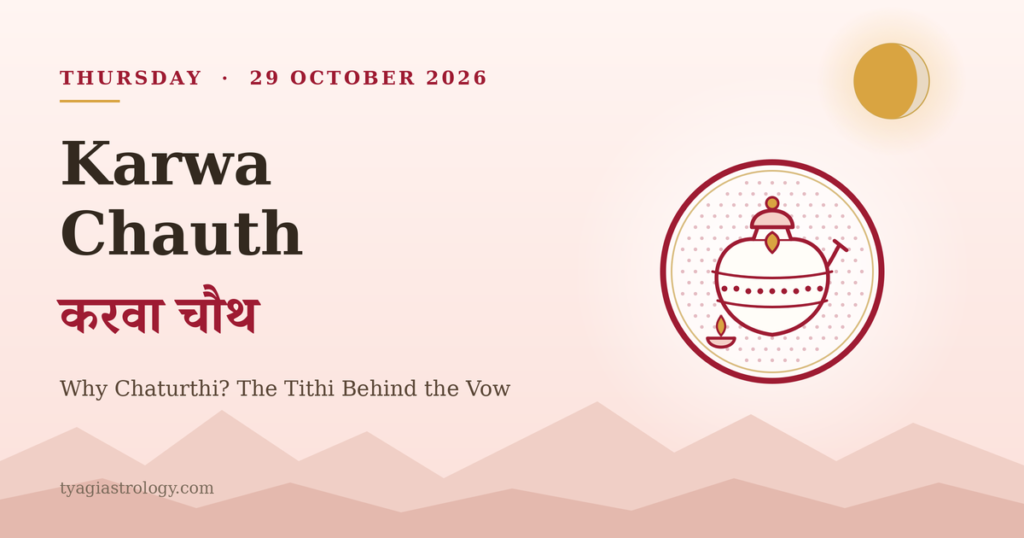

On Thursday, 29 October 2026, Kartik Krishna Chaturthi brings Karwa Chauth, the fast that many women in North India keep from sunrise until the Moon is seen. It is among the most visible festivals of the season and among the least examined. Where does it come from, what do the texts actually say, and why does a festival of the Moon belong in a conversation about astrology?
The short answer is that the Moon is the one heavenly body in Jyotisha that everyone can watch rise, and Karwa Chauth is built around waiting for it.
| Date | Thursday, 29 October 2026 (Kartik Krishna Chaturthi in the Purnimanta calendar; Ashwin Krishna Chaturthi in Amanta calendars) |
| Chaturthi tithi | From about 1:06 AM to about 10:09 PM on 29 October (Drik Panchang) |
| Fast | From sunrise (about 6:31 AM in Delhi) until moonrise |
| Puja muhurat, Delhi | About 5:38 to 6:56 PM |
| Moonrise, Delhi | About 8:12 to 8:17 PM, depending on the source; it varies by city |
| Moon | In Taurus; in Rohini until about 11 AM, then in Mrigashira |
| Same night | Sankashti Chaturthi (Ganesha vrata) and the Jain Rohini Vrat |
A few websites list 28 October. Karwa Chauth follows Chaturthi at moonrise, and in 2026 that falls on 29 October. Please check moonrise for your own city.
What the name tells us
Karwa is the small earthen water pot at the centre of the day, and chauth means the fourth. In Sanskrit vrata literature the observance is known as Karaka Chaturthi, from karaka, a pot of water. The pot is filled and decorated, used to offer water (arghya) to the Moon, and often exchanged or gifted afterwards.
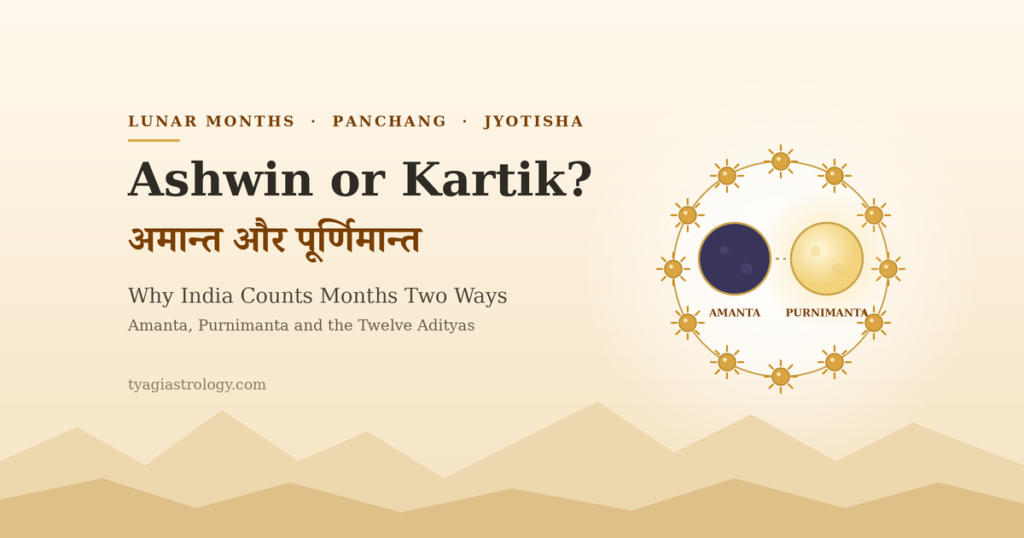
The month name causes some confusion. North Indian calendars that begin the month after the full Moon (Purnimanta) place the day in Kartik. Calendars that begin it after the new Moon (Amanta), followed in much of western and southern India, call the same day Ashwin Krishna Chaturthi. It is one night with two names.
The stories told at the puja
The fast has no single source text. Its stories come from the vrata-katha tradition, the tales recited by the women who gather for the evening puja, and different regions tell different ones.
The best known is the story of Queen Veeravati, the only sister of seven brothers. Fasting for the first time at her parents’ home, she grows weak by evening. Her brothers cannot bear to see her suffer, so they show her a lamp held behind a sieve in a tree and tell her the Moon has risen. She breaks her fast, and her husband falls gravely ill. Parvati appears and explains what went wrong. Veeravati repeats the fast with full devotion, and her husband recovers.
A second story explains the name. A devoted woman named Karva saves her husband from a crocodile by binding it with thread, then refuses to leave Yama’s door until he agrees to send the creature away, warning that she will otherwise curse him. Yama relents. In a third telling, Draupadi asks Krishna how to help the Pandavas, and he recalls that Parvati once kept this vow herself.
It is worth being clear about what these are. The Veeravati, Karva and Draupadi accounts are devotional narratives of the vrata tradition. They are not episodes of the Mahabharata or of a specific Purana that I could trace, and I would not cite them as scripture. The sieve comes from the Veeravati story; it does not appear to have an older ritual function.
Other explanations: friendship and the harvest
Several writers offer more earthly origins, and none of them excludes the devotional one. One suggests that Karwa Chauth began as a friendship bond between brides in their new homes, who exchanged decorated pots filled with bangles, ribbons and sweets. Another points to the calendar. The festival comes after the autumn harvest, around the time wheat is sown, and large clay karwas were used to store grain, so the vow may once have been a prayer for a good crop. These are theories, not documented history, but they explain why the day is tied to a pot.
Why the north: the Chauth Mata clue
Karwa Chauth is traditionally observed in Delhi, Punjab, Haryana, Rajasthan, Uttar Pradesh, Himachal Pradesh and Jammu, and it is far less common in the south and east. Its wider reach in recent decades owes a good deal to cinema and television, which carried the sieve, the decorated thali and the moonrise scene well beyond the northern belt.
The word chauth means more than the fourth day in Rajasthan. At Chauth ka Barwara in Sawai Madhopur district there is a hilltop temple of Chauth Mata, and the village takes its name from her. Local tradition dates the shrine to 1451, when the goddess is said to have appeared in a dream to the Chauhan ruler Bhim Singh and asked to be worshipped there. A replica shrine stands near Bundi, and both draw crowds at Karwa Chauth and Til Chauth.
Til Chauth, observed in Magha, is another Krishna-paksha Chaturthi vow kept by women, and Bahula Chaturthi, or Bol Chauth, in Bhadrapada is a third. So the dark-fortnight fourth day hosts a family of women’s vows through the year, for husbands in Kartik and for children at other times. This may help explain why Karwa Chauth is strongest in the north and north-west, where the cult of Chauth Mata is rooted.
The same tithi has a different face elsewhere. In Maharashtra and much of the south, Krishna Chaturthi is Sankashti, a Ganesha vow. On 29 October 2026 the two coincide: Karwa Chauth in the north and Vakratunda Sankashti Chaturthi elsewhere are the same Chaturthi under two identities.
Customs differ by region. In Punjab, for example, the mother-in-law sends a pre-dawn meal (sargi) before the fast begins, and in many places the women sit in a circle during the katha and pass their thalis from hand to hand.
Five things most people overlook
- The date follows the Moon, not the sun. The rule is that Chaturthi must be present at moonrise. In 2026 Chaturthi runs from about 1:06 AM to 10:09 PM on 29 October, so moonrise that evening falls inside it. The night before, the Moon rises during Tritiya, so 28 October does not meet the rule.
- The wait is long for an astronomical reason. Three days after the full Moon, the Moon rises roughly two and a half to three hours after sunset, because it rises about fifty minutes later each night. In Delhi that makes a fast of nearly fourteen hours, from about 6:31 AM to about 8:15 PM. The long wait is a feature of every year, not only this one.
- Three observances share one Moon. The same Chaturthi is Sankashti Chaturthi, the monthly Ganesha vrata that is also broken after the Moon is seen, and Jain households keep Rohini Vrat. Three traditions, one moonrise.
- Rohini at moonrise is not guaranteed. Popular articles often say the Moon rises in Rohini nakshatra on Karwa Chauth. This year the Moon is in Taurus, the sign of its exaltation, but Rohini ends about 11 AM and Mrigashira is the nakshatra at moonrise. The claim holds in some years and not in others.
- The practice keeps changing. Many households, even in North India, do not keep the fast. In some families husbands now fast alongside their wives, couples keep it together, and some women break the fast with fruit or water. Anyone who is pregnant or has a health condition would do well to speak to a doctor first.
Vedic Astrology and Karwa Chauth: Why Chaturthi? The Tithi Behind the Vow
Almost every account of Karwa Chauth explains the pot, the sieve and the story of Queen Veeravati. Almost none explains the tithi. Why is this vow tied to the fourth day of the dark half of Kartik, and not to Panchami or Saptami? Why is it called chauth so insistently that, in Rajasthan, the fourth day is a goddess with her own temples? I went looking for the answer.
In Sanskrit vrata literature the vow is called Karaka Chaturthi, from karaka, the water pot. Drik Panchang lists the Dharmasindhu, the Nirnayasindhu and the Vratraja as the works that mention it under that name. These are digests (nibandha) of ritual law. The Nirnayasindhu is generally dated to about 1612 and the Dharmasindhu to about 1790. If those dates hold, the formal textual footprint of Karwa Chauth that I could find is late medieval, not Vedic or epic.
The digests also give the date rule. The day is the one on which Chaturthi is present at moonrise (chandrodaya-vyāpinī). Notice what this means. The tithi is not an incidental detail. It is the whole definition of the day.
I did not find the vow in the Vedas, the Ramayana, the Mahabharata or a specific early Purana. The stories told at the puja, Veeravati, Karva and Draupadi, come from the vrata-katha tradition. None of the sources I found explains why Chaturthi was chosen. So the question has to be answered by looking at what Chaturthi is.
Every tithi has an owner
Each tithi has a presiding deity in the panchang tradition. The lists vary slightly, but the common version runs like this: Pratipada belongs to Agni, Dwitiya to Brahma, Tritiya to Gauri, Chaturthi to Ganesha, Panchami to the Nagas, Shashthi to Kartikeya, Saptami to Surya and Ashtami to Rudra, a form of Shiva. Drik Panchang puts it directly: the Chaturthi tithis belong to Ganesha.
Look at what that does to the calendar. Shiva’s family sits on consecutive tithis: Gauri on the third, Ganesha on the fourth, Kartikeya on the sixth, with Shiva himself on the eighth. A vow to Parvati and her family has a natural home on that stretch. Panchami, by contrast, belongs to the serpent deities, a different world.
This matches how Karwa Chauth is actually done. Drik Panchang describes the puja as worship of the Shiva family, with Parvati first, then Shiva, Kartikeya and Ganesha, and women also worship Gaura and Chauth Mata, both understood as forms of Parvati. Notice the name. In the vow’s own imagery the fourth day is a goddess. The tithi is personified.
The empty tithi
The thirty tithis are grouped into five types that repeat: Nanda (1, 6, 11), Bhadra (2, 7, 12), Jaya (3, 8, 13), Rikta (4, 9, 14) and Purna (5, 10, 15). Chaturthi is Rikta, the empty one. Muhurta texts generally do not favour Rikta tithis for new beginnings. Panchami, the tithi next to it, is Purna, the full one.
Here is my reading, and it is an interpretation. A tithi that is poor for starting things suits a vow aimed at getting through trouble. Chaturthi is the tithi of Ganesha as Vighnaharta, the remover of obstacles, and the monthly Krishna-paksha Chaturthi is Sankashti, a word that means deliverance from distress. The Karwa Chauth story is a story of exactly that: a calamity, a mistake and a recovery.
A tithi with a history with the Moon
This is the part I found most interesting. The Moon and Chaturthi have a story together, and it explains something odd about the calendar.
In a version of the Ganesha story attributed to the Skanda Purana, the Moon (Chandra) laughs at Ganesha’s form. Ganesha curses him. When Chandra begs forgiveness, Ganesha softens the curse in two ways: the Moon will wane in the dark fortnight, and no one should look at the Moon on Bhadrapada Shukla Chaturthi, the day of Ganesh Chaturthi, or they will face a false accusation. Other tellings link this to Krishna and the Syamantaka jewel.
So the same tithi treats the Moon in two opposite ways. In the bright fortnight of Bhadrapada, the Moon is not to be seen. In the dark fortnight, on Krishna Chaturthi, the Moon is waited for, worshipped and used to end a fast: that is Sankashti Chaturthi every month, and Karwa Chauth in Kartik. In Mithila the same Bhadrapada Shukla Chaturthi is Chaurchan, a festival that worships the Moon. Chaturthi is the day on which the Moon’s relationship with Ganesha is settled, and a vow that ends with moon-worship belongs there.
What the sky does that evening
A fast that ends at moonrise depends on when the Moon rises, and that changes by tithi. The Moon rises about fifty minutes later each night, so the delay after sunset grows steadily through the dark fortnight. I calculated sunset and moonrise for Delhi for the nights around Karwa Chauth 2026.
| Date | Tithi at moonrise | Moonrise, Delhi | After sunset | Moon lit |
| 26 Oct | Krishna Pratipada | 5:37 PM | about 0 min | 100% |
| 27 Oct | Krishna Dwitiya | 6:22 PM | 0 h 44 m | 97% |
| 28 Oct | Krishna Tritiya | 7:14 PM | 1 h 37 m | 92% |
| 29 Oct | Krishna Chaturthi (Karwa Chauth) | 8:15 PM | 2 h 39 m | 84% |
| 30 Oct | Shashthi (Panchami has no moonrise) | 9:21 PM | 3 h 46 m | 74% |
| 31 Oct | Krishna Saptami | 10:30 PM | 4 h 56 m | 63% |
| 1 Nov | Krishna Ashtami (Ahoi Ashtami) | 11:38 PM | 6 h 05 m | 51% |
My own calculation for Delhi using an astronomical library. Sunset and moonrise may differ from published panchangs by a few minutes.
Three things stand out. First, on Chaturthi night the Moon rises at about 8:15 PM, a little under three hours after sunset, still bright at 84 percent lit. That is late enough to follow the pradosh puja and early enough for an evening meal. Second, in 2026 Panchami never meets a moonrise at all. It passes between the 29th and 30th moonrises, so a ‘Karwa Panchami’ would have no moon to wait for this year. Third, by Ashtami the Moon rises near midnight, which is why Ahoi Ashtami four days later switches from the Moon to the stars.
I want to be careful here. No text I found says Chaturthi was chosen for this reason, and the sky alone would not rule out Panchami, whose moonrise is only about an hour later. This is my inference. But it shows that Chaturthi is where the story, the deity and the sky all agree.
So why Chaturthi? Five reasons that point the same way
- The tithi’s owner. Chaturthi belongs to Ganesha, and Parvati’s family sits on the third, fourth and sixth tithis.
- The Moon’s story. Chaturthi is the tithi on which Ganesha and Chandra are reconciled, and the dark half is when the Moon, by the curse, begins to wane.
- The empty tithi and the Sankashti theme. A Rikta tithi suits a vow for deliverance from trouble, and the monthly Krishna Chaturthi is already a moonrise fast.
- The sky. Chaturthi’s moonrise falls in the early evening, and by Ashtami it has moved to midnight.
- The place. Chauth Mata is a living goddess in the north-west, and Karwa Chauth is her Kartik festival.
What I could not find is a sentence in any source that says ‘Chaturthi was chosen because…’. The choice looks less like a decision than a convergence.
The popular view. Many astrologers present the day as a way to strengthen the Moon and Venus in a married woman’s chart, to support harmony in marriage. In 2026 the Moon is in Taurus, the sign of its exaltation and a sign ruled by Venus, and the day is a Thursday, Jupiter’s day, which some find fitting.
The reasoning, such as it is. A vow that trains patience and restraint for a day is read as a Moon exercise, since the Moon governs the mind. The Daksha story adds an echo: Chandra, married to the twenty-seven nakshatras, favoured Rohini and was cursed to wane, and Karwa Chauth falls in the waning half, with the Moon in Rohini on the morning of the fast this year. Rohini ends about 11 AM, so at moonrise the nakshatra is Mrigashira. This varies year to year.
Why I would read it as symbolism. Whether a marriage is happy depends on the two people. The Moon’s sign, the weekday and the nakshatra change every year, and the vow has continued through all of them. I treat the astrological overlay as a way of reading the day, not as a mechanism.
What the tithi gives the vow, in the end, is a shape: a long wait, an evening gathering and a Moon that arrives late and is worth waiting for. That does not need a chart.
Ask Fearlessly. Decide Wisely.
Saurabh Tyagi
Jyotiṣī with specialization in Jātaka and Muhūrta | Birth Chart Analyst